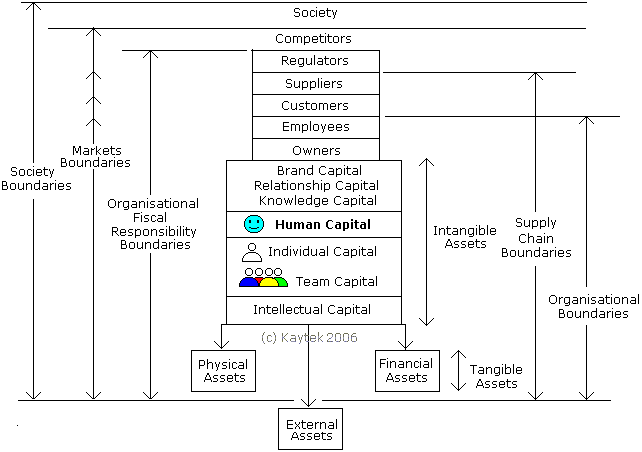
Organizational Assets Overview consisting of Tangible Financial, Physical Assets and Intangible Assets like Brand Capital, Relationship Capital, Knowledge Capital and Human Capital. The various boundaries starting from an organization & moving outwards are depicted below.
You can click on the image to enlarge the same.
In a global knowledge economy, intangible assets are the key to determine an organization's valuation.
The visual above depicts an organization's tangible and intangible assets and is a snapshot of the complexities involved in it's workings across the different types of asset classes and markets of different entities.
Tangible Assets are easy to understand, they are things that we can touch, feel and see - the physical and financial assets.
Intangible Assets consists of the following types of capital :
 Brand
Brand Capital
 Relationship
 Capital
Knowledge Capital
Intellectual Capital
Both at the
Individual level and also at the
Organizational Level.
The term
Human Capital also refers to both at the individual team (or group) level across the different types of human entities involved in an organization - Organization's owners, employees, customers, suppliers and regulators.
The
Organizational boundaries at the far right of the visual depict entities who are directly associated with an organization.
It's Employees, Owners and their interactions and involvement with various types of tangible and intangible assets mentioned above.
Supply Chain boundaries are organizational boundary limits plus the interactions or exchanges of an organization involving
Men (& Women), Methods,
Money, Markets, Materials,
Mortar-Brick, Machines,
Messages...
between it's owners, employees with it's customers, suppliers and other entities in different markets.
The
Organizational Fiscal Responsibility boundaries are the supply chain boundaries plus the various duties and responsibilities of the organization and it's owners, employees, customers and suppliers towards the statutory regulators of different types in different markets.
Also, for each of the employees, customers and suppliers, the organization also has the different market boundaries viz it's interactions in the employees markets, customer markets and supplier markets.
Finally, beyond the organization lies it's competitors and the rest of societal entities. These determine the organization's
Societal boundaries.
Some more thoughts :
Global Convertibility of
Knowledge Capital.
Importance Of Intangible Capital.
Organization As A
Table.
New Organizational
Assets.
Queries for an
Intellectual Capital Rating Tool.
Post-ERP
Increase in
Organizational Knowledge Capital ?
Where does money go in a
software company ?